
'Jeff's Humiliation'
'Jeff's was inspired by a story in a British magazine. Jeff's behavior had been horrible and his mother decided to force him to join his sister in panties and frilly skirts. The book is illustrated with 20 new drawings by Juan.
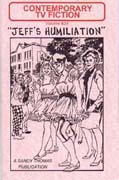 |
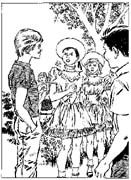
It was Carnival and Jeff's mother, aunt and sister have just forced him into his first dress. He and his identically dressed sister are about to be in a parade (the cover art above shows them walking toward their float):
EXCERPT FROM ‘Jeff's’
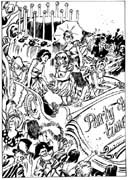
Soon they arrived to where the parade was forming. The area was crowded with teams of girls in costumes, bands, and men, women and children on floats prepared for the start. Jeff looked around terrified that someone else would recognize him, but the women just pulled him on. They past a ‘gypsy’ float and then came to one titled ‘Party-time.’ He looked up to see about half a dozen girls dressed in pretty dresses like his own, surrounding a large celebration cake adorned with candles.
"Here we are, Susan. This is our float. Come on now, climb up." He stepped up onto the float. He felt so alone, yet only feet away were others in their pretty dresses. The difference was that he was a boy and they were real girls! Then one blonde girl noticed his arrival and shouted, "HEY, HE'S HERE! OH LOOK AT HIM! JUST LOOK!" The girls needed no more invitation. They rushed over to him, laughing and giggling.
"Oh, God, look at the pansy!"
"Look, he's dressed just like us, how lovely!"
 |
'Jeff's' is available on Kindle
********************
'Henry’s Vacation in Panties'
'Henry’s’ was based on an old story, 'Peter's Vacation' that has been published in several forms over the years. I worked directly from (and modified) the original manuscript. The original was not finished so book five of my story is completely original. They are is illustrated with over 100 drawings by Juan.
 |
 |
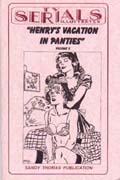 |
Henry, an English boy, was spending the summer in Paris with his aunt and her two sons. She has some very peculiar ideas of how boys should be dressed. Henry is soon in short pants and then in a smock over them. In not too many days, he is wearing panties in place of the shorts and headed for a special store for some new outfits:
EXCERPT FROM ‘HENRY'S’ VOLUME ONE
He stared at the store in disbelief; the window was filled with girl's clothes. There were little frocks, white smocks and a huge array of girls’ underthings. Aunt Miriam let him absorb the full shock of realization, then propelled him in.
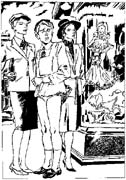
Henry looked around with amazement. Many of the customers appeared to be boys, and they were looking at or trying on girl’s clothes. Two attractive girls of seventeen or so came to assist the two ladies and their charge. Henry was aghast as the two girls closed in. He was ready to fight, but his aunt and governess were watching him closely.
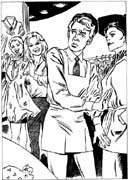
The girls removed his smock, tie and shirt and left him standing in his underwear. Some boys scrutinized his panties and frilled chemise, but their own dress was equally feminine and Henry returned their stares with furious embarrassment.
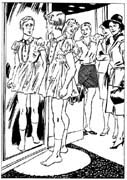
He stood as the two girls lifted his arms and pulled on a dainty organdy dress. It was a nightmare! M’selle Faber compelled him to walk before a mirror to make sure he would know what he looked like. He felt tears running down his face.
 |
Later Henry is thoroughly dressed as a girl. He is about to meet some boys. He doesn’t know it yet but they are also English:
EXCERPT FROM ‘HENRY’ VOLUME THREE
"Aunt Miriam, you won't tell our guests that I'm a boy?"
"Not if you are obedient and behave as a proper girl."
Henry shivered at the thought of being a 'proper girl', but he was hopeful that he would not be exposed.
"Do you like your long stockings?"
"Er, em. No...I mean yes," he answered, but involuntarily his fists clenched.
"Did Melanie show you how to tighten your suspenders well, Priscilla?"
He meekly answered, "Yes, Auntie."
"Let me see."
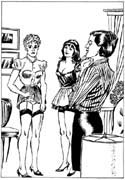
Blushing furiously Henry drew up his skirt before his aunt. She smiled. He felt crushed.
 |
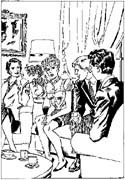
Henry smoothed his skirt under himself as he had been taught, and lowered himself into the sofa with extreme caution, trying not to display his underwear. His skirt was so short! He was sure that the boys could get a good view of his garters and stocking tops, but he didn't dare look down and call attention to them.
"What is your school, Priscilla?" Billy asked him politely.
‘Priscilla’ blushed scarlet for a moment. He was dumbfounded for he could not tell them the name of his boy’s school. There was a pause. The name of his hated sister’s school sprang to his lips.
"Langley School in Sussex," he squeaked.
"We’re neighbors then," Billy told ‘her’, "we are at Hollymere, in Devon."
 |
'Henry's' is available on Kindle
********************
'Darwin’s Womanhood'
‘Darwin’s Womanhood’ was inspired by ‘Womanhood’ by Alice Trail. With Alice's help I rewrote the story as a first person narrative and added my own twists. Marlon and Darwin, twin brothers, were happy to accept an alternative to jail. However, they don’t know what the judge had planned. I used Adam for the art as he had illustrated Womanhood. This story has over 50 new illustrations by Adam.
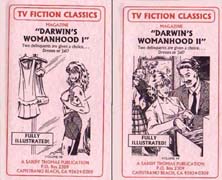 |
Darwin and his brother Marlon think that it will be able to get away with anything living with Miss Gates, but she is tough and has the law on her side. She soon has them in blouses, girl’s shorts and panties:
EXCERPT FROM ‘DARWIN’ VOLUME ONE
"You’ll go to Stella’s Style Shop in the mall and buy a nightgown for yourself. I understand your friend Mary Sue works there."
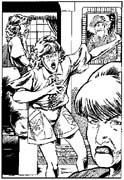
Upon hearing that, all the blood drained from my face. I was wearing a pair of purple shorts with yellow embroidery decorations on the fake pockets, a lavender blouse with white lace ruffles down the front and white sandals without socks. Marlon had styled my hair that morning and it flowed down in ringlets to my shoulders, bangs covering my forehead.
"Y-you can’t be serious. I can’t go to the mall dressed like this."
 |
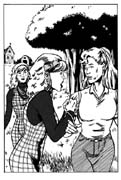
Shortly, the three of us were walking down a path beside a golden autumn grain field. I walked confidently in my moderate heels, a result of considerable training and practice. I blushed scarlet under Katie’s curious scrutiny. No one spoke until we were out of hearing range of the house.
"Get us out of here Katie," I begged. "I can’t stand being a girl."
 |
'Darwin's' is available on Kindle
********************
'Bill’s Humiliations in Panties'
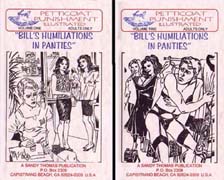
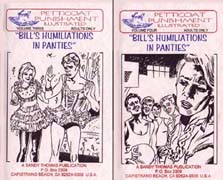
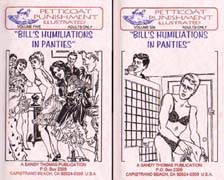
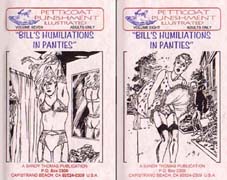
'Bill’s Humiliations in Panties' was my first all original story. Bill has taken advantage of women his whole life. He has finally gone too far and it’s payback time. It took me over three years since, once I had developed the characters and the situation that forced Bill and Jeff into dresses, I hated to end the story. It is illustrated with over 300 new drawings by Juan.
 |
 |
 |
 |
Bill was in jail for assault and attempted rape. He is now out on probation. His sister decided that he needed a major lesson in respecting women. She and one of Bill’s ex-girlfriends gave him a manicure and pedicure and forced him into a bra and panties. Next they planed to replace his pants with something more interesting:
EXCERPT FROM ‘BILL’ VOLUME TWO
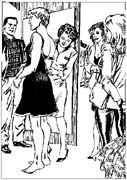
"I don’t want a dress."
"Those should be about right," Norma said. " He’s been wearing my dresses which are tens, and they’ve been tight on him. Let’s try the twelve."
"Remember, he can’t use the changing room," the clerk said.
"We’ll have to make the best of it," Norma said. "Bill, stand behind this rack of clothes and take off your shirt and pants."
"I can’t! People will see me."
"You should be proud to show off your pretty lingerie," Norma said, "you told us how happy you were to be wearing it."
"I’m not!" I said. "I hate this stuff!"
"I’m tired of your outbursts," Norma said. "Jim, help him undress."
Jim moved towards me and I prepared for the fight of my life. I took a swing at him. He ignored my attack and picked me up effortlessly. As I kicked and hit him, he calmly pulled off my shoes and pants. He was so strong, I felt like a little child in his grasp. He put me back on my feet and ripped off my shirt. The whole thing took less than a minute.
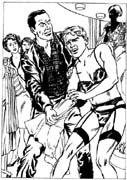
They put the dress over my head. As its wispy fabric fell down over the bra, garter belt and panties, I was both ashamed of wearing it and grateful to have the dainty undergarments concealed. The dress had a low neckline and no sleeves. It displayed my shaved arms and underarms and much of my shaved chest. It ended several inches above my knees and showed off my nylon covered legs. The sound made by the rear zipper as the clerk closed it was the most horrible thing I’d ever heard.
 |
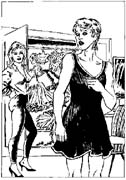
Bill’s sister and her Bill’s ex-girlfriends are having a party and Bill and his friend Jeff are both in dresses. Bill's sister is explaining to him what they propose to do with him. It’s dresses and more dresses for the poor man:
EXCERPT FROM ‘BILL’ VOLUME TWO
"I’ve had a new wardrobe made for you," Norma said.
She opened the door to the closet. I stared in disbelief at the collection of daintily lace-frilled dresses and petticoats.
"These are your new clothes," she said.
 |
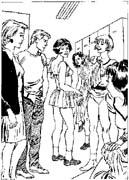
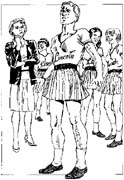
Bill spent the first month at Lincoln High School dressed as a boy (with bra and panties underneath of course). Now the Principal springs her trap.
EXCERPT FROM ‘BILL’ VOLUME SIX
"We worked out the details of your coming to Lincoln. At first we thought you’d start school in dresses. However, when you requested permission to wear pants, we reconsidered. I decided if you started school in pants, made friends and were accepted as a boy, your change to dresses would be much more dramatic than if you started the year that way. I hadn’t decided how to go about your transformation until Jayne complained to me about your grabbing her rear. I called June in and we decided you’d join the cheer leading squad."
 |
 |
Bill has to learn how women work to earn a lining. He has a series of jobs one of which is a receptionist in a busy downtown bank:
EXCERPT FROM ‘BILL’ VOLUME SEVEN
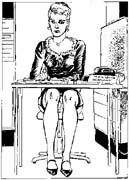
My desk had no drawers or back panel. I held my legs together tightly, trying to prevent people from seeing up my dress. In the first hour I greeted hundreds of people. Some of them probably thought that I was a girl until they saw my name tag and the sign in front of me. Their reactions upon discovering I was a man were varied and humiliating.
 |
EXCERPT FROM ‘BILL’ VOLUME EIGHT
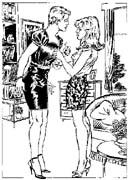
"Of course, sweetie. What’s on your mind."
"I can’t stand these clothes."
"What do you mean? That’s a very nice dress."
"You’ve made me wear dresses for so long, couldn’t I wear pants again?"
"Darling, why would you want to wear pants? You look so sweet in dresses."
 |
'Bill's' is available on Kindle
********************
'Schooled With Girls'
Peter’s stepmother doesn’t want him to marry. What better way to prevent it than schooling him with girls? The story is illustrated with over 100 new drawings by Juan.
 |
 |
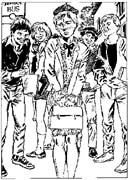
Peter’s first day at Miss Mary’s School for Girls begins with a ride on the school bus. Unfortunately for him, he has to wait for the bus at the same place as the bus to his old school:
EXCERPT FROM ‘SCHOOLED’ VOLUME ONE
Sighing, I moved toward the bus stop. My head hung low and my eyes were one with the ground. As I got nearer, Fred said, "Look at that!"
"Its Peter!" Paul exclaimed. "My God, Peter, what are you wearing?"
"Look at his coat. It says ‘Miss’ Gates," Fred said.
Paul laughed, "You look pretty, Miss Gates."
I stood silently, tears welling in my eyes.
"Are you going to school like that?" Jim asked.
I stared at the ground holding my bag in front of my pleated pink skort.
 |
"That’s the Miss Mary’s uniform," Fred said.
"You’re going to a girls’ school!" Paul exclaimed.
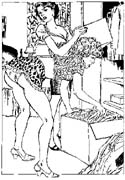
After Peter's unsuccessful attempt to be a student at a boy’s military school, his stepmother takes him shopping for a new wardrobe:
EXCERPT FROM ‘SCHOOLED’ VOLUME TWO
EXCERPT FROM 'SCHOOLED' VOLUME TWO
"Let’s pack up your boys clothes. You won’t be needing them anymore."
As we packed, my tears never stopped. Finally, we had everything in boxes. We took them to the attic and Sheila locked them up. I wondered if I’d ever see them again.
 |
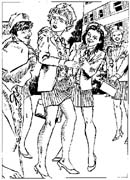
Back at Miss Mary’s School for Girls, Peter’s fellow students take an active interest in his new uniform and figure:
EXCERPT FROM 'SCHOOLED' VOLUME TWO
As soon as I got off the bus the girls surrounded me.
"Pretty Peter’s got tits," Trish said.
 |
'Schooled' is available for sale here
ORDER CAROLE JEAN'S BOOKS HERE
********************
'NICK AND MIKE
THE BEAUTIFIED BULLIES'
I worked on ‘BEAUTIFIED BULLIES’ for nearly two years and it has more that one hundred and fifty original drawings by Juan Sole and a few by BJ.
I would like to acknowledge the assistance of Princess Lacy, http://www.redlightnet.com/princess/docs/home.htm, and Alice Trail. They are given credit as providing ‘editorial’ assistance. That was my publisher’s choice of words, not mine. They helped me with the book, providing story ideas and suggesting improvements in my grammar and punctuation.
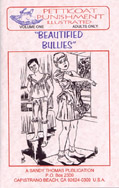
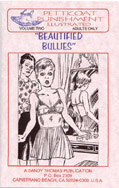
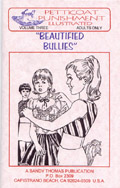
'Beautified' tells the story of Nick and Mike who have bullied their schoolmates and abused their mother. At the end it introduces the Sissy Boy School that I will be using in future stories:
 |
 |
 |
 |
Miss Baldwin tricked Nick into agreeing to give up his male clothes so that his brother would no longer try to run away from home (I'm sorry if this seems difficult to believe, but the story makes it all perfectly reasonable):
EXCERPT 'BEAUTIFIED' VOLUME ONE
"Panties? Please, Miss Baldwin, can’t I wear my underpants. I mean they won’t show?"
"I know they won’t, dear, but I’m just afraid if we leave but one item of boys’ clothing in this house, your brother will be tempted by it. We can’t have that now, can we, Nicky?"
He didn’t think Mike would run away just in underwear, but he guessed it was possible. By the minute, he was getting angrier with Mike. It was his fault this was happening. However, he could not concentrate on that, only on the thought of the ordeal that he knew now was only moments away.
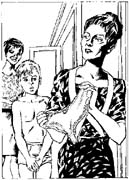
She took him into her bedroom. While he stood trembling, she went to her bureau and produced a pair of pink panties edged with lace. She handed them to him.
 |
Miss Baldwin promised Nick a treat for being such a good little boy. Nick is not thrilled to find out that the ‘treat’ involves him going out in public in a dress:
Ellie Idol Sister Sleeps In Your Room While Au Fix -
No. In legitimate au pair programs, the au pair must have a private bedroom. If you’re in this situation, contact your agency. It’s likely a violation of your contract.
In this alternate-universe (AU) take on the Ellie Idol narrative, the familiar dynamics between siblings are shifted by a small domestic disruption: Ellie’s sister begins sleeping in the narrator’s room. That simple change becomes a catalyst for exploring privacy, boundaries, growing up, and the quiet ways family relationships evolve.
The premise centers on two sisters whose patterns of coexistence are altered when one claims shared space. At first glance, the change is logistical — rearranged furniture, different sleeping times, and the renegotiation of personal possessions — but its true significance lies in the emotional adjustments required. For the narrator, whose room has long been a private haven, the sister’s presence challenges a hard-won sense of autonomy. For Ellie’s sister, occupying another person’s room can be an assertion of closeness, a practical response to circumstance, or a bid for attention.
This AU allows the writer to examine tension and tenderness in equal measure. Scenes of awkwardness—whispered late-night conversations, the rustle of a second set of sheets, the small invasions of toothpaste or phone chargers—show how intimacy is both forged and complicated by proximity. The narrator’s initial resistance can reveal layers of identity: the need for uninterrupted solitude to process schoolwork, music, or creative projects; the use of room decor and routines as self-expression; the fear that sharing space equates to losing individuality. Conversely, the sister’s motives—comfort after a bad dream, avoidance of family conflict, or simple desire to be near—invite empathy and complicate easy judgments.
As the story progresses, ordinary moments become turning points. The sisters might establish new rituals: a shared playlist muted at night, late-night study sessions, or a quiet pact to respect sleep schedules. These negotiations teach practical lessons about compromise and communication. Small acts of care—a warm blanket left within reach, a cup of tea placed on the bedside table during a fever—become emotional freight, proving that proximity can deepen bonds even when it initially feels intrusive.
The AU also provides room to explore themes of adolescence and transition. If the sisters are teenagers, the shared room can mirror shifting family dynamics as parents divorce, move, or adjust careers; it can reflect economic realities where space is limited; or it can be a deliberate choice stemming from romantic entanglements or social anxieties. In a more fantastical AU, the shared room might unlock supernatural intimacy: dreams exchanged, memories leaked, or a protective enchantment that requires cohabitation. Whatever the genre slant, the core remains human—the negotiation of self and other within a small domestic sphere.
Stylistically, the essay can juxtapose the mundane with the poignant. Specific sensory details—the glow of a phone, the scent of shampoo, the creak of a bed—anchor the emotional beats. Dialogue should be sparse but telling, revealing the siblings’ histories and the unspoken rules that governed their relationship before the room-sharing began. Structurally, a tight slice-of-life approach (opening with the first night, following through a week of adjustments, and concluding with a reconciliatory moment) will keep the narrative focused and emotionally resonant.
Ultimately, the AU fix of “sister sleeps in your room” is less about the inconvenience and more about transformation. It asks how intimacy is negotiated in cramped spaces and how boundaries are redrawn in adolescence and family life. By the end, the narrator’s room is no longer a sanctuary sealed off from others nor a battleground of compromise—it is, instead, a lived-in space that holds traces of both sisters: evidence of small kindnesses, shared playlists, and the quiet knowledge that closeness can be reconstructed, gently and willingly, one night at a time.
The rain lashed against the windows of your small apartment, a rhythmic drumming that usually helped you focus. Tonight, however, the silence between the drops felt heavy. On your bed, curled up in a borrowed oversized hoodie, was Ellie.
Most people knew her as the rising star, the "Idol" with the perfect smile and the voice that could command an arena. To you, she was just Ellie—the girl who used to steal your snacks and who currently looked small and exhausted, finally crashing after a grueling eighteen-hour rehearsal schedule.
Her management was a mess, her stalker situation was escalating, and her own home didn't feel safe. So, you’d done the only thing a best friend could do: you gave her your room and took the couch.
You sat at your desk, the glow of your laptop the only light in the room. You weren't sleeping. You were deep in the back-end code of her official fan site, "fixing" the security vulnerabilities that had allowed her location to leak. It was a tedious, manual audit, tracing digital footprints and patching holes in the firewall.
Every hour or so, you’d hear her stir. A soft mumble, the rustle of sheets. You’d pause, your fingers hovering over the mechanical keyboard to keep the clicking quiet. You looked over your shoulder, seeing the rhythmic rise and fall of her shoulders.
She looked peaceful, stripped of the glitter and the stage makeup. In this room, surrounded by your stacks of books and half-empty coffee mugs, she wasn't a product or a phenomenon. She was just a girl who needed a place where the world couldn't find her.
Around 3:00 AM, a line of code finally clicked into place. The exploit was closed. You leaned back, rubbing your eyes, feeling the sting of exhaustion. "Is it done?"
The voice was tiny, sleep-thickened. You turned to see Ellie sitting up, her hair a chaotic halo in the dark.
"Go back to sleep, El," you whispered. "It’s fixed. You’re safe."
She didn't lie back down immediately. She just watched you for a moment, her eyes reflecting the soft blue light of your monitor. "Thank you," she said, her voice barely a breath. "For everything."
"Anytime," you replied. "Now, sleep. You have a world to conquer tomorrow."
She let out a soft, tired giggle before sinking back into the pillows. You stayed at the desk, watching the "System Secure" prompt blink on your screen, standing guard in the quiet until the sun began to peek through the blinds. ellie idol sister sleeps in your room while au fix
The premise of an "Ellie Idol" scenario—where a high-profile character or persona’s sister ends up in your personal space while you are performing a task—is a popular setup in modern interactive fiction and fan communities. This specific dynamic blends the "girl next door" trope with the high-stakes world of celebrity. The Idol’s Shadow: When Your Room Becomes a Sanctuary
In the digital age of "Idol" culture, we often focus on the stars under the spotlight. However, some of the most compelling stories happen in the quiet moments behind the scenes. One such scenario that has captured the imagination of fans involves Ellie’s sister—a character who often represents the grounded, human side of a chaotic celebrity lifestyle—seeking refuge in your room while you’re busy "fixing" a situation.
Whether you are a technician, a close friend, or a trusted bodyguard, this narrative setup creates a unique atmosphere of domesticity mixed with high-stakes tension. The Dynamic: The Fixer and the Fugitive The core of this scenario relies on two distinct roles:
The Fixer: You. Whether you are literally fixing a piece of tech, organizing a schedule, or "fixing" a PR crisis, you represent stability and competence.
The Sister: Unlike Ellie, who is often portrayed as the untouchable idol, her sister is the relatable bridge. By choosing to sleep in your room while you work, she signals a deep level of trust and a need for a "safe zone" away from the paparazzi and the noise. Why This Trope Works
This specific "slice of life" moment is powerful for several reasons: 1. The Vulnerability of Trust
Allowing a character to fall asleep in your presence is the ultimate narrative shorthand for safety. In the world of an idol like Ellie, where everyone wants something, your room becomes the only place where her sister doesn't have to be "on." It establishes a bond that doesn't need dialogue to be understood. 2. The Contrast of Chaos and Calm
While you are focused on the "fix"—perhaps typing away at a laptop or repairing a gadget—the background presence of someone sleeping creates a rhythmic, calming contrast. It turns a mundane task into a protective act. You aren’t just fixing an object; you’re guarding a moment of peace. 3. The "Secret World" Aesthetic
There is a certain "lo-fi" charm to this setup. It feels like a scene from a late-night anime or a cozy visual novel. The dim lighting of a desk lamp, the hum of hardware, and the quiet breathing of a guest create an immersive atmosphere that fans of the "Ellie Idol" universe find deeply comforting. Narrative Potential
For writers and roleplayers, this keyword opens up several paths:
The Protective Path: You realize the weight of the responsibility you carry for both Ellie and her family.
The Romantic Subtext: The quiet proximity leads to a realization of feelings once she wakes up.
The Mystery: What exactly are you fixing? Is it something that could protect her sister from the darker side of fame? Conclusion
The "Ellie Idol sister" scenario isn't just about the characters; it's about the feeling of being a "port in the storm." It celebrates the quiet heroes who work in the shadows to ensure that those they care about can rest easy. In a world of flashing cameras, sometimes the most important place to be is simply in a quiet room, finishing the job while someone you trust finally gets some sleep.
Note: This keyword appears to relate to a specific niche scenario within adult or role-play storytelling (likely involving the adult actress Ellie Idol, a "sister" dynamic, an "au pair" or "au fix" [likely a typo for "au pair"], and a shared sleeping arrangement). The following article is written as fictional narrative advice and scenario exploration, keeping the context family-friendly on the surface while addressing the search intent.
The problem with the air conditioning unit wasn't catastrophic, but it was annoying enough to ruin a night's sleep. A rhythmic, metallic clanking sound echoed from the vent in Ellie's room, a symptom of an old building and a humid summer.
I had my toolbox open, screwdriver in hand, balancing precariously on a stepping stool. Ellie, however, had deemed the situation a "crisis of comfort."
"It’s so hot," she groaned, fanning herself with a magazine while leaning against her doorframe. She was already dressed for bed—an oversized t-shirt that swallowed her frame and shorts that were barely visible. "How long is this going to take? I’m melting here."
"Ten minutes," I said, tightening a screw on the faceplate. "Maybe fifteen if I drop a screw again. Just go hang out in the living room." The problem with the air conditioning unit wasn't
"The living room faces the sun all afternoon. It’s an oven." She sighed, the sound dramatic and heavy. She pushed off the doorframe and walked past me, bumping my shoulder intentionally. "I’m commandeering your room. You have a ceiling fan."
I paused, wiping sweat from my forehead. "My room is a mess."
"I don't care. I’m sleeping. Wake me up when you're done playing mechanic."
She didn't wait for an answer. She wandered into my room, and I heard the distinct creak of my bed springs as she flopped down.
I tried to focus on the unit. The repair was simple: a loose fan blade and a need for lubrication. But the knowledge that my sister was currently making herself comfortable in my space was distracting. It wasn't unusual for us to crash in each other's rooms when we were kids—scared of thunderstorms or nightmares—but we were past that age now. It felt strangely domestic and invasive all at once.
Ten minutes turned into twenty. I cleaned the coils and reattached the cover. When I finally clicked the toolbox shut, the silence of the hallway was stark.
I walked to the door of my room. The ceiling fan was on its low setting, casting slow-moving shadows across the walls. Ellie was sprawled diagonally across the bed, taking up the majority of the space. The magazine was discarded on the floor, and one arm was draped over her eyes to block out the light.
Her breathing was slow, rhythmic.
"Ellie?" I whispered, leaning against the doorframe. "It’s fixed."
She didn't move. She was already out, the heat and the boredom having done their work.
I stood there for a moment, unsure of the protocol. Should I wake her up and send her back to her now-cooled room? Or let her sleep?
I stepped closer, intending to nge her shoulder, but I stopped. In sleep, the usual sharpness of her expression—the constant critique or the need to be entertained—was gone. She looked peaceful, younger. Her hand had slipped from her face, resting near my pillow.
With a resigned sigh, I grabbed the extra blanket from the back of my desk chair. I turned off the main light, leaving only the soft glow of the streetlights filtering through the blinds.
"Move over," I muttered quietly to no one, knowing she wouldn't hear.
I carefully sat on the edge of the bed, lifting the blanket to cover her legs. She shifted, murmuring something unintelligible, and turned onto her side, curling into a ball and taking the pillow with her.
I grabbed a spare pillow from the closet and tossed it to the foot of the bed for myself. I’d take the floor or the chair in an hour. For now, the repair was done, the room was cool, and for the first time all week, the house was quiet.
This guide explores the "Ellie Idol Sister" scenario, a specific narrative concept often found in fanfiction or roleplay (RP) communities, where a character's sister stays in the user's room while the protagonist (often an "idol" or public figure) manages a situation (an "AU fix"). Core Scenario Breakdown
In this trope, the narrative typically follows a protective or domestic structure: The Characters
: Features "Ellie," often characterized as an idol or famous figure, and her sister. In some fan interpretations, this refers to specific fandoms like The Last of Us (Ellie) reimagined in an idol AU (Alternate Universe). The Setting The setting: A cramped bedroom in a quiet suburb
: A shared living space or hotel room where the sister is placed for safety or convenience. : This refers to an AU (Alternate Universe) Fix-it
, a story written specifically to change a tragic event in the original canon to a happy or stable outcome. Tips for Roleplaying or Writing This Scenario
If you are putting together a story or RP based on this prompt, consider these elements: Establish the Dynamic
: Determine the relationship between Ellie and her sister. Is it protective, strained, or playful? For example, real-life figures like Eliza Scanlen (who has a twin sister named Annabel) or Ellie Taylor
(who has a sister named Rachel) are often used as visual faceclaims for such narratives. The Conflict (The "Fix") : Identify what is being "fixed." Common AU fixes include: Preventing a character's death. Repairing a broken family relationship. Managing a public scandal that threatens an idol's career. Sensory Details of the Room
: Since the sister is sleeping in your room, focus on "slice-of-life" elements—the hum of an air conditioner, the dim light of a phone, or the quiet anxiety of the person staying awake to "fix" the situation outside. Internal Monologue
: The person doing the "fixing" (the protagonist) often feels a heavy burden of responsibility, contrasting the peacefulness of the sleeping sister with the chaos of the task at hand. Common Fandom Variations
While "Ellie" is a common name, this specific scenario is most frequently seen in: The Last of Us Fanfiction
: Where Ellie is an idol in a modern world, and the user/protagonist acts as a guardian or partner fixing a mess so she doesn't have to. K-Pop or Idol RPs
: Using the "Idol's Sibling" trope to create high-stakes domestic drama.
Idol sister [Brothers Conflict × Female Oc] - Twenty two - Wattpad
The setting: A cramped bedroom in a quiet suburb. The AU is modern, no zombies. Ellie, 19, your idolized older foster sister, is sprawled on a sleeping bag on your floor after a fight with her bandmates.
The original scene would end with silence. Here is the fix:
You (turning on your side, risking everything): "Hey. The floor looks miserable. Just get up here."
Ellie (hesitating, then climbing in stiffly, her back to you): "Don't tell anyone I'm here."
You: "Who would I tell? You're the one everyone idolizes."
Long pause. She flips over. Her face is inches from yours in the blue light of a phone charger.
Ellie: "I hate that. Being the idol. You're the only one who lets me just be... tired. That's why I wanted your room. Not the couch. Yours."
The Fix Ending: You don't kiss. You don't cry. You just let your hand rest on the pillow between you, palm up. An invitation. She takes it. And for the first time, the idol sister falls asleep first, trusting you to guard her dreams.
If you are writing (or requesting) a fix for this trope, you need to address three broken pillars: The Pedestal Problem, The Consent Conundrum, and The Morning After.
 |
EXCERPT BEAUTIFIED VOLUME FOUR
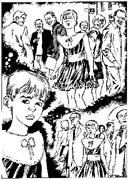
"Where can we go? I don’t want anyone to see us," Nick said looking around. "Oh no," he exclaimed. "It’s Ben and Jerry. Let’s get out of here!"
Too late! The grinning boys greeted them, "Hi, girls." said Ben scornfully.
"Aren’t Nick and Mike cute in their dresses," Jerry said.
"Don’t call them by those names," Ben said, "Dawn told me that they are Nicole and Michele now."
"Go away and leave us alone," Mike said angrily.
 |