Screenshots

Icon Only

One Day Info

Several Days
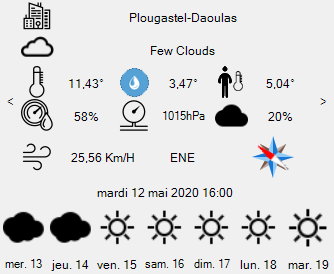
Detail Window
A powerful .NET NuGet control for weather forecasts, supporting 9 weather API providers. Compatible with .NET Framework 4.6.2+ and .NET 8.0.
Download Demo SampleChoose the provider that fits your needs. Switch providers with a single property — no code changes required.
| Provider | Enum Value | API Key | Free Tier |
|---|---|---|---|
| OpenWeatherMap Free | OpenWeatherMapFree |
Required | Free |
| OpenWeatherMap One Call 3.0 | OpenWeatherMapOneCall |
Required | Subscription |
| Open-Meteo | OpenMeteo |
Not required | Free |
| WeatherAPI.com | WeatherApi |
Required | Free tier |
| Visual Crossing | VisualCrossing |
Required | Free tier |
| Tomorrow.io | TomorrowIo |
Required | Free tier |
| Meteo-Concept | MeteoConcept |
Required | Free tier |
| Meteoblue | Meteoblue |
Required | Paid |
| XWeather | XWeather |
Required (client_id|client_secret) | Paid |
Overview:
A management utility feature that allows an application to interface with the MultiKey emulator driver to verify link status, load specific key definitions (.reg or .dmp files), and troubleshoot connection errors without restarting the host machine.
Note: Provided for educational understanding of reverse engineering risks, not for illegal use.
If you are developing or maintaining a system that manages these types of drivers or licenses, here is a requested feature design:
If this request relates to bypassing software protection for unauthorized purposes, please be aware that modifying or emulating security dongles without vendor permission may violate software license agreements and intellectual property laws. This feature set is designed strictly for legitimate administrative management (e.g., creating backups of owned licenses or running legacy software on modern hardware without physical ports).
Alternative Context: If "1811 Link" refers to a specific network protocol code, an error code in a Rockwell Automation PLC context, or a specific API error, please clarify the industry or software platform you are using (e.g., "Rockwell RSLinx," "SAP," "Gaming Anti-Cheat"), and I can provide a more targeted feature.
1.1 emulator/driver. This software is typically used as a USB dongle emulator for CAD/CAM software or other protected applications. MultiKey 18.1.1 Resources
Official Documentation: MultiKey does not have a central "official" brand website, as it is often distributed through specialized technical forums or alongside specific industrial software packages.
GitHub Repositories: You can often find the source code or compiled versions of MultiKey on GitHub. Searching for "MultiKey 18.1.1" on the platform may yield developer-maintained forks.
Technical Forums: Communities like Team-Viewer or Exetools often host discussions and links for specific versions of MultiKey drivers, though these require careful vetting for security. Important Security Note
Because MultiKey is a driver-level emulator, it requires disabling Driver Signature Enforcement on Windows to function. Always ensure you are downloading from a trusted source and scan all files with updated antivirus software, as these tools are frequently flagged or bundled with unwanted software.
ITU-T Recommendation X.1811 (approved April 2021) addresses the cryptographic threats posed by quantum computing to International Mobile Telecommunications-2020 (IMT-2020) systems. A "multikey" approach in this context refers to cryptographic schemes that allow operations on data encrypted under different, unrelated keys—a critical capability for secure multi-party computation in distributed networks like 5G. 1. ITU-T Recommendation X.1811 Overview
Purpose: Identifies security threats from quantum computing and assesses the strength of current cryptographic algorithms in 5G systems.
Scope: Provides guidelines for implementing both symmetric and asymmetric quantum-safe algorithms to maintain long-term data integrity and confidentiality. multikey 1811 link
Official Resource: The full standard is available through the ITU-T X.1811 Recommendation Database. 2. Multikey Cryptographic Mechanisms
The "multikey" aspect typically involves advanced encryption methods designed for collaborative environments:
Multikey Fully Homomorphic Encryption (MFHE): Enables computations on data encrypted under different keys without needing to decrypt the data first. To see the final result, all involved parties must cooperate to decrypt it.
Quantum-Safe Transition: X.1811 recommends transitioning to algorithms (like lattice-based cryptography) that are resistant to quantum attacks. Many of these modern algorithms are inherently suited for multikey or threshold schemes.
Session Key Exchange: In IMT-2020 systems, session keys are used for real-time signal encryption, while a separate "key-encrypting key" (multikey structure) protects the distribution of those session keys. 3. Strategic Recommendations for Implementation
Assess Algorithm Strength: Use the ITU-T X.1811 guidelines to evaluate whether current infrastructure can withstand commercial quantum computers.
Hybrid Keying: Implement a combination of classical and quantum-safe algorithms during the transition period to ensure "link" security for legacy and future devices.
Privacy-Preserving Computation: Leverage multikey schemes for edge computing and IoT scenarios where data from multiple users must be processed collectively without exposing individual inputs.
This technical paper/standard provides security guidelines for protecting mobile networks against quantum computing threats using "quantum-propagation-safe" (often referred to as post-quantum) algorithms. Core Technical Paper
ITU-T Rec. X.1811 (04/2021): This is the primary standard that discusses security protocols such as IPsec and TLS in the context of emerging 5G/IMT-2020 systems, specifically evaluating candidates like SIKE and NewHope for perfect forward secrecy. Related Research on "Multikey" Systems
If your query is specifically about Multikey Homomorphic Encryption (which is frequently cited in papers alongside large numeric identifiers or protocol lists), the following recent paper is a leading resource:
On Circuit Private, Multikey and Threshold Approximate Homomorphic Encryption: This paper (published in 2025/2026) provides a formal study on multikey homomorphic encryption schemes, which allow computation on ciphertexts from different parties. It explores how these schemes relate to circuit privacy and multiparty computation. Hardware Reference Overview: A management utility feature that allows an
Dallas Semiconductor DS1991 MultiKey iButton: In older technical catalogs (often found in digital archives), the DS1811 is listed as a 5V EconoReset chip, while the DS1991 is the designated "MultiKey" iButton used for secure storage.
MultiKey is a versatile emulator that allows software to run without a physical hardware dongle by mimicking the data that the software expects to find. Version 18.1.1 (often called 1811) is a common iteration for 64-bit Windows environments. 1. Prerequisites and Installation Driver Signature Enforcement
: Since MultiKey is often an unsigned or third-party driver, Windows 10/11 users usually need to disable "Driver Signature Enforcement" via the Advanced Startup menu or use "Test Mode" to allow the driver to load. x64 Support
: Ensure you have the version specifically labeled for 64-bit systems if you are running a modern version of SolidCAM or similar engineering software. 2. Registry Configuration
The emulator functions by reading "dumps" (data files) from the Windows Registry. Registry Path : Data is stored under:
[HKEY_LOCAL_MACHINE\System\CurrentControlSet\MultiKey\Dumps\xxxxxxxx] is the 8-character hex password for the key. Dongle Types
: MultiKey supports several types of hardware locks, identified by a DongleType DWORD value: : HASP (3, 4, HL, SRM) : HARDLOCK : SENTINEL (SuperPro, UltraPro) : GUARDANT TestProtect 3. Common Setup Steps Prepare the Registry File : Most guides provide a
file containing the specific data for the software license you are trying to emulate. Import to Registry : Double-click the
file to add the license information to the path mentioned above. Install the Emulator install.cmd included with the MultiKey package as an Administrator.
: A system restart is often required to initialize the driver and allow the software to recognize the "virtual" dongle. Important Security & Legal Note
Using emulators like MultiKey to bypass hardware protection may violate software license agreements. Additionally, because these tools often require disabling security features like Driver Signature Enforcement, they can expose your system to stability issues or malware if obtained from untrusted sources. Manual of MultiKey - TestProtect
Keywords used: multikey 1811 link, Multikey 1811, multikey 1811 link troubleshooting, RS-422 keyboard extender, vintage KVM link, 1811 multiplexer protocol. If this request relates to bypassing software protection
Here’s a draft blog post based on the keyword “multikey 1811 link”.
Since the exact meaning of “multikey 1811 link” isn’t standard in public knowledge, I’ve framed it as a technical or productivity topic (e.g., a shortcut, keyboard mapping, or automation tool). You can adjust the specifics to match your actual product or use case.
Title: Unlock Efficiency: How the MultiKey 1811 Link Transforms Your Workflow
Intro
If you’ve ever juggled multiple shortcuts, complex macros, or software toggles, you know the friction of switching between tools. Enter the MultiKey 1811 Link – a compact yet powerful solution for binding multiple actions to a single key sequence or link.
What Is the MultiKey 1811 Link?
The MultiKey 1811 Link isn’t just another hotkey tool. It’s a mapping system that lets you chain commands (keystrokes, URLs, scripts, or even API calls) behind one memorable trigger – the “1811” profile. Whether you’re a developer, designer, or power user, it reduces repetitive tasks into a single link or keypress.
Key Features
Real-World Use Case
Imagine starting your daily report: instead of opening three apps, running two scripts, and copying a timestamp, you just type Win + 1811 (or click a saved link). The MultiKey 1811 Link opens your analytics dashboard, pulls yesterday’s data, inserts the date, and saves a draft – all in under two seconds.
Getting Started
Why 1811?
The “1811” in the name isn’t random – it’s the default profile for 18 actions, 1 trigger, 1 link. (You can rename it, but early testers found the number easy to remember.)
Final Thoughts
The MultiKey 1811 Link turns tedious sequences into a single tap or click. It’s small, flexible, and surprisingly addictive once you start building your own chains.
Try it today – and let us know your most creative 1811 link in the comments.
If your remote stops working:
Icon Only
One Day Info
Several Days
Detail Window
Copyright (c) 2020-2026 JYL Software
Permission is hereby granted, free of charge, to any person obtaining a copy of this software and associated documentation files (the "Software"), to deal in the Software without restriction, including without limitation the rights to use, copy, modify, merge, publish, distribute, sublicense, and/or sell copies of the Software, and to permit persons to whom the Software is furnished to do so, subject to the following conditions:
The above copyright notice and this permission notice shall be included in all copies or substantial portions of the Software.
THE SOFTWARE IS PROVIDED "AS IS", WITHOUT WARRANTY OF ANY KIND, EXPRESS OR IMPLIED, INCLUDING BUT NOT LIMITED TO THE WARRANTIES OF MERCHANTABILITY, FITNESS FOR A PARTICULAR PURPOSE AND NONINFRINGEMENT. IN NO EVENT SHALL THE AUTHORS OR COPYRIGHT HOLDERS BE LIABLE FOR ANY CLAIM, DAMAGES OR OTHER LIABILITY, WHETHER IN AN ACTION OF CONTRACT, TORT OR OTHERWISE, ARISING FROM, OUT OF OR IN CONNECTION WITH THE SOFTWARE OR THE USE OR OTHER DEALINGS IN THE SOFTWARE.
If you find this control useful, consider supporting further development.